Lead 2026: Keynote summary
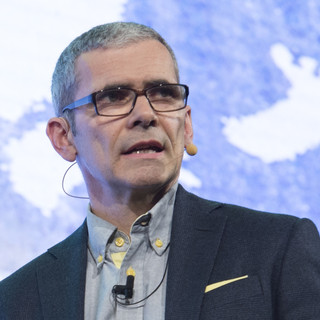
Here are the key points covered in Ade McCormack's October 2026 keynote at Seminarium's Lead 2026 conference, along with the slide deck.
The Intelligent Organisation
Harnessing the power of AI
Key points
Act 1 – A changing world
If you lead an established organisation, it is very likely that it was designed using principles that work well in a predictable environment.
AI is not just a technology but a macroenvironmental force that is likely to radically change both business and society.
The percentage of the global stock markets that rely on AI delivering as promised is a concern, because the value proposition has not yet been established.
But AI is not the only force bearing down on our organisation. Remember, Pestle and Pestilencia.
The media, consultancies and many leaders are focusing on the symptoms in respect of the challenges their organisations face, rather than the structural issues that need attention.
Increasing disruption is leading to an increasingly unpredictable environment. This is an issue when our organisations were built for certainty.
Act 2 – An unchanging organisation
Traditional organisations can be viewed through six lenses:
Value – The focus tends to be on short-term profitability.
Organisational design – Often, an inelegant collection of overlapping process flows.
Leadership – Highly centralised decision making.
Innovation – Considered as a non-core activity.
People – Utilised as process cogs rather than for their cognitive capacity.
Technology – A big focus on digital transformations that typically fail. AI today is not intelligent, though it can appear intelligent.
Act 3 – A new way of thinking
It is useful to think of the market as moving from a finite game of fixed rules, like football, to an infinite games, like a barroom brawl.
The ability of an organisation to stay in the game is a measure of its intelligence. Think of this as street smartness, rather than being well credentialled.
The mechanical approach of the industrial model is unable to cope with the increasing uncertainty that we face today.
It is recommended that we focus on three lenses going forward:
Viability – Stay in the game.
Vitality – Thrive.
Value – Matter to our ecosystem(s).
In respect of viability:
Respond – Our organisation’s ability to sense what is happening in its environment and respond in real-time. Think Sense – Decide – Act.
Adapt – By taking a cellular approach and embracing the behaviour of living systems.
De-risk – Eliminate single points of failure. In particular, the risk associated with only having one business model.
Vitality
Nurture – Create a workplace that plays to our humanity. Think cognitive athlete.
Channel – Leaders and managers need to become cognitive coaches.
Performance – Reward people based on performance and not simply activity. AI is a ‘natural’ extension in terms of how we might augment our cognitive athletes.
Value
Create – Focus on creating value for all stakeholders, rather than just shareholders or clients.
Capture – In creating value for others, we must create value for our organisations. First plug the value leaks and then work on the marginal value gains.
Accumulate – Think of viability, vitality and value as intangible asset classes. These are assets that demonstrate the organisation’s ability to navigate an unknowable future. They comprise the governance structures that demonstrate good practice in these areas along with the mechanisms to measure and demonstrate progress.
Viability, vitality and value are regenerative. Improvements in any of these will lead to improvements in all of them. This becomes the organisational value flywheel, which leads to compounding momentum and even greater value creation.
Act 4 – New thinking meets old practice
Developing an intelligent organisation from a mechanical one on the face of it seems like an impossible task.
Act 5 – A practical way forward
You have options in respect of how you respond to increasing disruption:
Do nothing – This requires keeping your fingers crossed!
Mimic the behaviours of a living system – Traditional organisations already do many of these quite well. Most struggle with responsiveness and very few can truly adapt.
Embrace the ‘three Vs’.
Viability – Rather than trying to turn a mechanical, process-centric organisation into a living system, start to develop / acquire start-ups and scale-ups where you can implement living systems practices from the outset. It is important that these new organisations are not all in your current market. You are looking to build a diversified portfolio of business models and thus eliminate the single point of failure issue associated with operating only in one market.
Vitality – Vitality is about turning cognition into innovation and thus value. Living systems inform us that innovation is random, high volume and is ‘crowdsourced’. The challenge is that it involves a high degree of failure, which violates industrial era principles. The upside is that you have the cognitive potential in your people to support the innovation process, not least in respect of ideation. It just needs to be tapped. This requires a rethink in respect of how corporate governance is perceived.
Value - The immediate next step is to measure the organisation’s activities and performance in respect of the 3 Vs along with their associated key actions.
These immediate steps will serve to:
Eliminate your organisation’s existential risk.
Get the best from your people and thus attract the best people.
Develop a value-centric organisation culture.
AI has a key role to play in the 3Vs. But AI cannot simply be added to a traditional business model.
AI, given its probabilistic nature is well suited to a world that will be driven more by biological principles than mechanical. Uncertainty trumps certainty. Thus AI is critical to the future of business and society.
I encourage leaders to adopt these three new lenses:
Viability.
Vitality.
Value.
Intelligent organisations behave like living, sensing organisms. The biggest gains can be made by treating your people as augmented cognitive athletes, where you are the cognitive coaches.
Dive deeper
The presentation was developed and delivered by Ade McCormack through his Intelligent Organisation work.
Learn more about the Intelligent Organisation.
Learn more about Ade McCormack.